Why Does My Die Cutting Press Leave Uneven Edges on Leather?
Five Common Causes
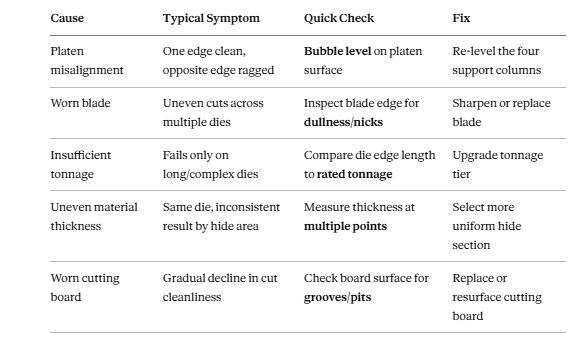
1. Platen Misalignment If the platen lands even slightly tilted, one side of the die gets full pressure while the other gets less — enough to leave uncut fibers on long, straight cutting lines.
2. Worn or Dull Blade Edge A blade that has cut thousands of cycles gradually loses sharpness. Dull sections leave ragged, incomplete cuts even when tonnage and alignment are otherwise correct.
3. Insufficient Tonnage for the Die A die with long total cutting edge length demands more force. Undersized tonnage cuts thinner sections cleanly but fails on thicker or harder spots.
4. Uneven Material Thickness Natural leather often has thickness variation across a single hide, especially near the shoulder. The same die can cut cleanly on one section and roughly on another.
5. Cutting Board Wear A worn or gouged cutting board loses its flat support surface, causing inconsistent backing pressure and uneven cut depth across the die's contact area.
Cause Comparison Table
FAQ — 6 Questions & Answers
Q1: How do I know if it's the machine or the material? Re-cut the same die on a different section of leather. If the result changes, material thickness variation is the likely cause, not the machine.
Q2: Can platen tilt really cause this on a small angle? Yes. Even a one-to-two-degree tilt is enough to leave uncut fibers on dies with long, straight cutting lines, though small dies may show no visible effect.
Q3: How often should the cutting board be replaced? Replace it once you see visible grooves or pitting at the die contact points — a worn board causes inconsistent support even with a sharp blade.
Q4: Does blade sharpening fix uneven edges permanently? It resolves dullness-related unevenness, but if the root cause is platen tilt or tonnage, sharpening alone won't fully eliminate the problem.
Q5: Is uneven cutting more common on certain die shapes? Yes — dies with long, straight edges are more sensitive to tilt and tonnage shortfalls than small, simple, symmetrical shapes.
Q6: How often should I check platen leveling? Check every few months, and always after moving or relocating the machine, since minor bumps can shift alignment without any obvious sign.